
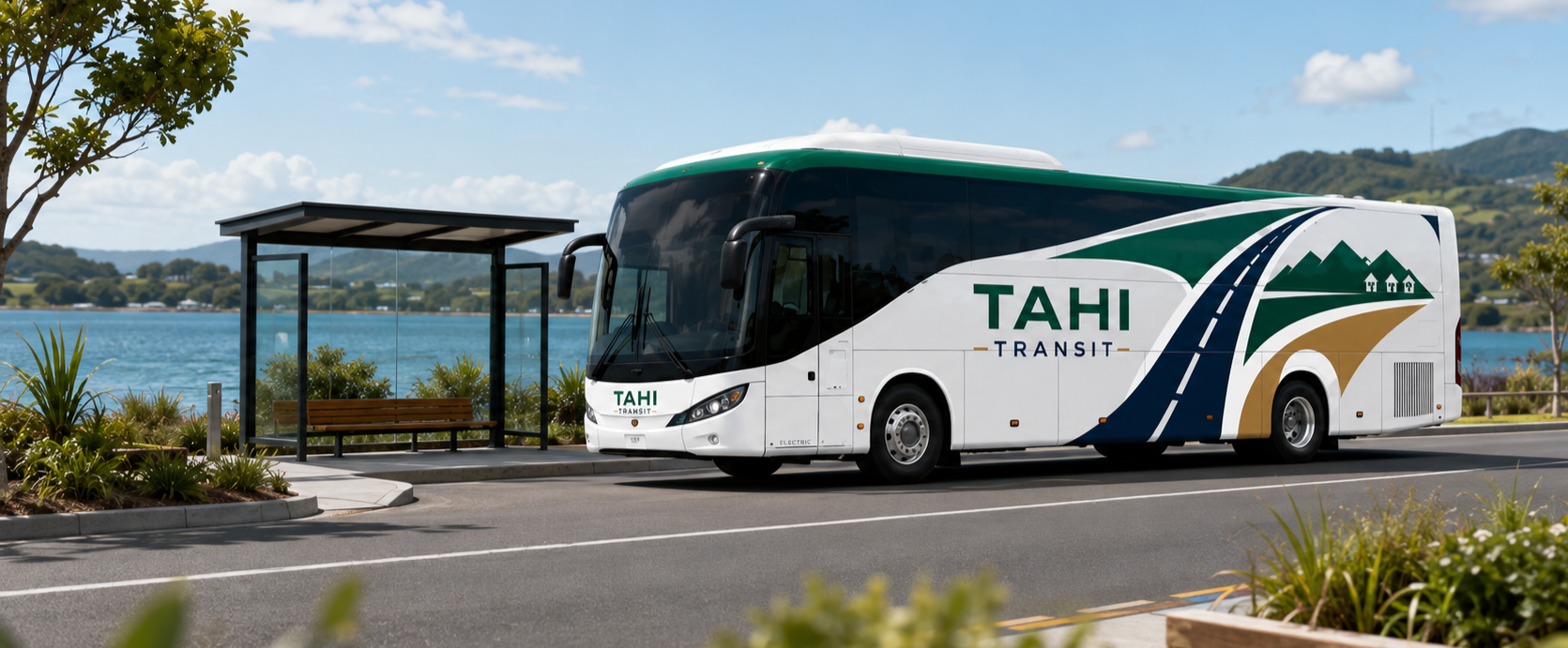
Electric Fleet & Sustainability
Tahi Transit is built around the future of public transport: fully electric, environmentally responsible and locally grounded.
We believe electric buses are only the beginning. A sustainable public transport network also needs smart route planning, reliable charging, disciplined maintenance, trained drivers, careful energy management, cultural respect, local employment and a long-term commitment to the communities it serves.
Our approach is practical, planned and service-first.
The fleet must be sustainable.
The service must still turn up.
Built Around Fully Electric Public Transport
Tahi Transit has been created for a new generation of council and government transport contracts.
Public transport is changing quickly. Councils need operators that can move beyond diesel thinking and deliver reliable, clean, quiet and efficient electric bus services without compromising service reliability.
That requires more than buying electric buses.
It requires the whole operation to be designed around electric performance: routes, range, charging, depot layout, maintenance, driver behaviour, monitoring, spare fleet planning and disruption response.
Tahi Transit is built for that environment.
Our electric operating model is designed to support safe, reliable and fully electric public transport across urban networks, school services and regional connector routes.
Electric Buses Are Only the Beginning
A successful electric bus network depends on the system behind the vehicle.
The bus on the road is the visible part. Behind it sits a full operating model that must work every day: charging infrastructure, energy supply, route scheduling, battery monitoring, driver training, depot supervision, maintenance planning and contingency cover.
Tahi Transit approaches electric public transport as a complete network.
Our planning considers:
Route length and vehicle range
Charging windows and charging speed
Depot and charging layout
Power supply and infrastructure resilience
Battery health and vehicle monitoring
Driver training for electric vehicle operation
Maintenance and diagnostic requirements
Spare vehicle planning
School and peak-period demands
Disruption and emergency response
Energy use and emissions reporting
Passenger comfort and accessibility
Electric buses are quieter, cleaner and better for the environment, but they must also be dependable. Our focus is to make electric public transport work in the real world, not just on paper.
A Service-First Electric Fleet
For Tahi Transit, sustainability cannot come at the expense of reliability.
Passengers still need to get to school, work, appointments, shops and home. Councils still need services to run to timetable. Drivers still need vehicles that are ready, safe and suitable for the route.
That is why our electric fleet approach is service-first.
We plan electric operations around the realities of public transport: peak demand, school bell times, traffic delays, road conditions, charging availability, weather, battery performance and unexpected disruptions.
Our goal is simple: clean transport that people can trust.
Charging Strategy and Depot Readiness
Charging is one of the most important parts of electric bus operations.
A well-planned charging system protects the whole network. A poorly planned one creates risk: missed trips, rushed decisions, vehicle shortages and service disruption.
Tahi Transit’s charging and depot approach considers:
Depot layout and safe vehicle movement
Overnight and opportunity charging
Charger placement and capacity
Charging schedules matched to route duty cycles
Energy demand across the operating day
Vehicle rotation and parking plans
Charging fault response
Spare vehicle access
Driver and depot staff training
Data monitoring and reporting
Future fleet growth
The depot is not just where buses park. For an electric fleet, the depot becomes the energy centre of the operation.
Tahi Transit is designed to manage that responsibility carefully.
Route Planning for Electric Performance
Electric fleet planning begins with the route.
Every route has its own operating profile: distance, speed, hills, traffic, dwell time, passenger load, layover time and charging opportunity. A bus that works well on one route may not be the right answer for another.
Tahi Transit takes a practical route-by-route approach.
We consider how vehicles will perform across the full service day, not only in ideal conditions. That includes peak traffic, school loadings, poor weather, detours, recovery time and the need for spare operational capacity.
Good electric planning means asking the right questions early:
Can the vehicle complete the duty reliably?
Is there enough charging time?
What happens if traffic delays the route?
What spare capacity exists if something fails?
How does the plan protect the passenger service?
Our goal is to design electric operations that are sustainable, realistic and resilient.
Driver Training for Electric Bus Operations
Electric buses drive differently.
They are quieter, smoother and more efficient, but they also require specific driver knowledge. Driving style can affect passenger comfort, vehicle range, battery performance and overall service reliability.
Tahi Transit’s driver training model supports:
Safe electric vehicle operation
Smooth acceleration and braking
Regenerative braking awareness
Passenger comfort
Energy-efficient driving
Range awareness
Charging procedures
Vehicle fault reporting
Accessibility and boarding procedures
Emergency response
Customer service standards
Drivers are central to electric fleet performance. With the right training and support, they help protect safety, reliability, energy efficiency and the passenger experience.
Maintenance, Monitoring and Fleet Reliability
Electric buses reduce some traditional maintenance requirements, but they introduce new responsibilities.
Battery systems, charging interfaces, diagnostics, software, high-voltage safety, electric drivetrains and vehicle monitoring all need disciplined management.
Tahi Transit’s fleet reliability model focuses on:
Daily vehicle readiness checks
Preventative maintenance planning
Battery health monitoring
Charging system oversight
Defect reporting and rectification
Vehicle diagnostics
Safety and compliance checks
Accessibility equipment checks
Cleaning and presentation
Spare vehicle planning
Long-term asset care
A sustainable fleet is not only low-emission. It is well maintained, well monitored and ready for service.
Environmental Sustainability in Daily Operations
Tahi Transit’s environmental responsibility goes beyond the tailpipe.
Fully electric vehicles are the foundation, but sustainable transport also depends on the way the operation is managed every day.
Our environmental approach includes:
Low and zero-emission fleet operation
Efficient energy use
Route and timetable planning that reduces waste
Careful depot energy management
Maintenance that protects vehicle performance
Reduction of unnecessary idling and waste
Cleaner, quieter passenger services
Responsible procurement where practical
Measured performance over time
Continuous improvement with council partners
We want public transport to reduce environmental impact while improving mobility for the people who rely on it.
Clean transport must be practical transport.
Cultural Sustainability and Respect for Place
Sustainability is not only environmental.
For Tahi Transit, sustainability also means respecting the people, whakapapa, identity and local knowledge of the places we serve.
Public transport moves through communities every day. It should reflect those communities with care and respect.
Our cultural sustainability approach is built around:
Listening early
Respecting mana whenua
Supporting local relationships
Understanding community needs
Encouraging local employment
Reflecting local identity where appropriate
Supporting bilingual communication where suitable
Treating cultural respect as part of operations, not decoration
Every region has its own story. Public transport should not feel imposed on a place. It should feel connected to it.
Social Sustainability and Local Value
A public transport contract should leave a community stronger.
Tahi Transit believes sustainable transport includes local jobs, stable employment, driver development, respectful workplaces, local supplier relationships and services that improve access for people who need them most.
Our model supports social value through:
Local recruitment where practical
Driver training and career pathways
Stable employment opportunities
Respectful workplace standards
Passenger dignity and accessibility
School and youth mobility
Support for older passengers
Better access to work, education and services
Long-term local relationships
Public transport is one of the most practical ways to improve daily life. It connects people to opportunity, independence and community.
Accessibility and Passenger Comfort
Electric public transport should work for everyone.
A modern bus network must be accessible, comfortable and easy to use for commuters, students, disabled passengers, older passengers, parents, visitors and people who rely on public transport every day.
Tahi Transit supports passenger-focused electric services through:
Accessible boarding
Clean and well-presented vehicles
Smooth, quiet travel
Professional driver behaviour
Safe boarding and alighting
Clear communication
Respectful passenger care
Reliable school and peak services
Consistent service standards
The future of public transport should not only be cleaner. It should be easier, calmer and more inclusive.
Reporting, Data and Transparency
Sustainability needs to be measured.
Councils need clear information about how services are performing. That includes not only reliability and safety, but also energy use, fleet availability, emissions impact, maintenance trends and improvement opportunities.
Tahi Transit’s reporting approach can support:
Service reliability
On-time performance
Fleet availability
Charging performance
Energy consumption
Vehicle utilisation
Maintenance performance
Safety incidents
Customer feedback
Emissions reporting
Continuous improvement actions
Good reporting helps council partners see what is working, where risk is emerging and where the service can improve over time.
We believe transparency builds trust.
Resilience and Contingency Planning
Electric operations need strong backup planning.
A reliable operator must be ready for charging faults, power interruptions, vehicle issues, road closures, weather events, peak demand, driver absence and unexpected service disruption.
Tahi Transit plans for resilience through:
Spare vehicle strategy
Charging contingency planning
Route and duty-cycle review
Incident escalation procedures
Driver and depot communication
Maintenance response
Council notification processes
Service recovery planning
Post-incident review and improvement
A strong electric network is not one that assumes nothing will go wrong. It is one that is prepared when something does.
Responsible Growth
Tahi Transit has been built for long-term public transport partnerships.
We understand that councils need suppliers who can grow carefully, manage risk, control costs, protect service quality and support community outcomes over the life of a contract.
Our approach to growth is disciplined.
We do not believe in overpromising. We believe in planning properly, operating honestly, measuring performance and improving continuously.
Sustainability must be financial, operational, environmental, cultural and social.
That is the standard Tahi Transit is building toward.
Electric. Reliable. Connected.
Tahi Transit’s fleet and sustainability model is built around three simple commitments.
Electric — because public transport must support a cleaner future.
Reliable — because passengers and councils need services that turn up.
Connected — because transport should reflect the people, places and communities it serves.
Our commitment is to deliver fully electric public transport that is practical, responsible, culturally respectful and dependable every day.
Frequently Asked Questions
Is Tahi Transit built for fully electric bus operations?
Yes. Tahi Transit is built around fully electric public transport. Our operating model considers vehicles, charging infrastructure, route planning, depot management, driver training, maintenance, monitoring and contingency planning.
Why is electric bus planning more complex than buying electric buses?
Electric buses require a complete operating system behind them. Route length, charging windows, battery range, depot layout, energy supply, driver behaviour, vehicle monitoring and spare vehicle planning all affect service reliability.
How does Tahi Transit approach sustainability?
Tahi Transit treats sustainability as environmental, cultural, social and operational. That includes fully electric buses, energy management, local employment, cultural respect, passenger accessibility, responsible reporting and long-term contract discipline.
How does Tahi Transit manage electric fleet reliability?
Tahi Transit’s electric fleet model includes daily readiness checks, battery monitoring, charging oversight, preventative maintenance, driver training, spare vehicle planning and clear incident response processes.
Does Tahi Transit support cultural sustainability?
Yes. Tahi Transit believes public transport should reflect the place it serves. Our approach includes listening early, respecting mana whenua, supporting local relationships and making cultural respect part of daily operating decisions.
How does electric public transport improve the passenger experience?
Electric buses are quieter, smoother and cleaner. Combined with good driver training, accessibility standards, clean vehicles and reliable operations, they help create a calmer and more comfortable public transport experience.