
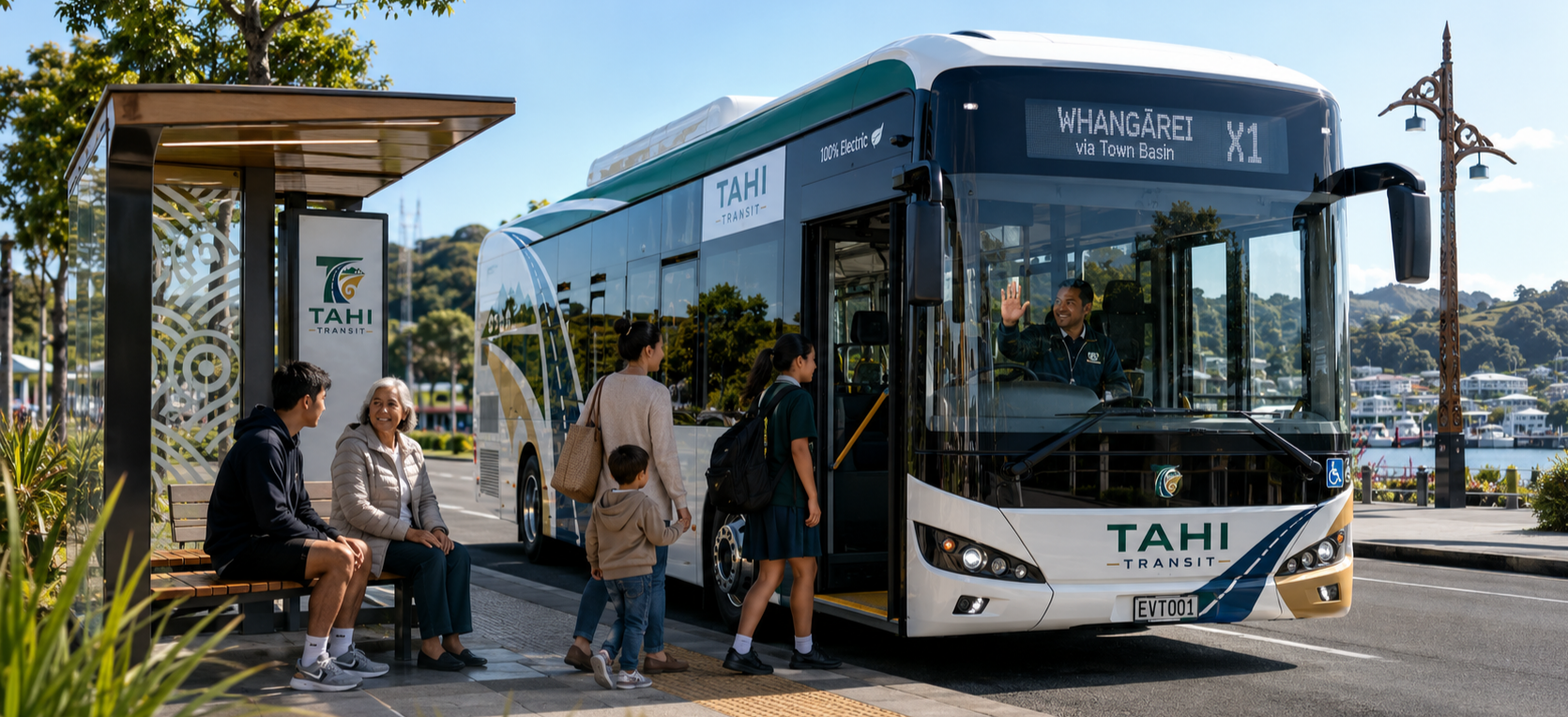
Community & Culture
Public transport belongs to the community.
Tahi Transit believes a bus service should do more than move vehicles through a route. It should connect people to school, work, whānau, health services, shops, appointments, independence and opportunity.
For Tahi Transit, community and culture are not side issues. They sit at the centre of how we plan, recruit, communicate and operate.
We are building a public transport company that is locally accountable, culturally respectful, environmentally responsible and focused on the daily needs of the people it serves.
Public Transport That Reflects the Place It Serves
Every region has its own identity.
Its own roads, schools, communities, histories, relationships, passenger needs and expectations. A successful public transport operator must understand that the same operating model cannot simply be dropped into every place.
Tahi Transit believes public transport should reflect the place it serves.
That means listening early, learning from local knowledge, respecting mana whenua, supporting local employment and understanding that a bus service is part of the social fabric of a community.
A timetable is important.
A vehicle is important.
But trust is what makes a public transport network work.
Local Accountability Matters
Public transport works best when the operator is visible, responsive and accountable.
Councils need an operator that communicates clearly. Passengers need a service they can rely on. Drivers need support. Schools and community groups need confidence that issues will be taken seriously.
Tahi Transit is built around local accountability.
Our approach includes:
Listening to council and community expectations
Building local relationships early
Supporting local recruitment where practical
Understanding route-specific passenger needs
Responding quickly to issues and feedback
Being visible and accessible as an operator
Treating public transport as a long-term responsibility
Protecting the reputation of the public network
We do not believe in being a distant operator. We believe in showing up properly.
Respect for Mana Whenua
Tahi Transit recognises that public transport in Aotearoa operates across whenua with deep whakapapa, identity and cultural significance.
Respect for mana whenua cannot be treated as decoration. It must be part of how a company listens, plans and behaves.
Our approach is to engage respectfully, listen before assuming, and ensure cultural considerations are treated as practical operating matters rather than symbolic additions.
That may include:
Early and respectful engagement where appropriate
Understanding local cultural context
Supporting bilingual communication where suitable
Reflecting local identity in passenger-facing services where appropriate
Avoiding tokenistic use of cultural design or language
Seeking proper advice before using Te Reo Māori or cultural references
Building relationships based on respect, not presentation
For Tahi Transit, cultural respect means doing the work properly.
Te Reo Māori and Bilingual Communication
Tahi Transit supports the thoughtful use of Te Reo Māori.
Where appropriate, we intend to support bilingual communication across public-facing material, signage, digital content and passenger information. This must be done carefully, accurately and respectfully.
Te Reo Māori should not be treated as a design feature. It is a taonga.
Our approach is to use qualified translation, seek local guidance where appropriate and ensure any bilingual communication is clear, useful and culturally safe.
A bilingual public transport service should help people feel seen, included and respected.
Cultural Sustainability in Daily Operations
Sustainability is not only environmental.
For Tahi Transit, sustainability also means protecting relationships, respecting local identity, supporting whānau, creating stable employment and ensuring public transport strengthens the communities it serves.
Cultural sustainability means that the service should feel connected to place.
It should be reflected in:
How we recruit
How we train staff
How we speak with passengers
How we engage with schools and community groups
How we design passenger communication
How we respond to complaints and feedback
How we support local employment
How we make decisions over the life of a contract
Culture is not something to add at the end. It is something to consider from the beginning.
Local Employment and Workforce Development
A public transport contract should create local value.
Tahi Transit believes that transport services are stronger when they support local employment, driver development and stable long-term jobs.
Drivers are more than employees. They are the face of the public transport network. They greet passengers, support students, assist older people, manage difficult moments and represent the service every day.
Our workforce approach supports:
Local recruitment where practical
Driver training and development
Stable employment opportunities
Respectful workplace standards
Clear expectations and support
Safety and wellbeing
Career pathways within transport operations
Pride in serving the local community
When drivers feel respected and supported, passengers feel the difference.
Supporting Whānau, Students and Everyday Passengers
Public transport is part of everyday life.
For some passengers, it is a convenient way to move around town. For others, it is essential. It may be how they get to school, work, health appointments, shopping, sport, study, social connection or whānau.
Tahi Transit designs its approach around the real people who use the service.
That includes:
Students travelling to and from school
Workers relying on early and peak services
Older passengers maintaining independence
Disabled passengers needing accessible transport
Parents travelling with children
People without access to a private vehicle
Visitors learning how to move around a region
Communities needing reliable regional links
A good public transport service gives people confidence. It helps them plan their day, participate in their community and stay connected.
Passenger Dignity and Care
Every passenger should be treated with dignity.
Tahi Transit believes passenger care is part of both culture and safety. A bus service can meet a timetable but still fail the community if passengers feel ignored, unsafe or unwelcome.
Our passenger care approach includes:
Respectful driver behaviour
Calm communication
Safe boarding and alighting
Patience with older passengers
Support for disabled passengers
Care around students and young people
Clean and welcoming vehicles
Clear response to feedback
Consistent service standards
A culture of respect on board
Public transport earns trust through small daily moments.
A helpful driver.
A clean bus.
A safe boarding experience.
A service that turns up when expected.
A complaint handled properly.
These are the details that build community confidence.
Accessibility and Inclusion
Public transport should work for everyone.
Tahi Transit supports accessible, inclusive and easy-to-use services for passengers with different ages, abilities, confidence levels and travel needs.
Accessibility is not only a vehicle feature. It is an operating standard.
It includes:
Low-floor bus operation
Safe kerbside positioning
Ramp checks and driver awareness
Clear passenger communication
Care for older passengers
Support for disabled passengers
Pram and mobility aid awareness
Clean, uncluttered vehicle interiors
Consistent driver training
Respectful passenger assistance
An inclusive service is one where people do not have to fight to use it.
Schools and Young People
School services carry a special responsibility.
Students, parents, schools and councils need public transport that is calm, safe, consistent and well managed.
Tahi Transit understands that school transport is not just about moving students from one stop to another. It is about trust. Parents need to know their children are travelling on a service with appropriate drivers, clear standards and proper escalation if something goes wrong.
Our school service approach supports:
Safe loading and unloading
Calm driver behaviour
Consistent standards
Student dignity and respect
Communication with council and schools
Clear incident escalation
Reliable morning and afternoon delivery
Careful management of busy peak periods
For young people, public transport can be one of their first experiences of independence. That experience should be safe, respectful and reliable.
Community Feedback and Listening
A public transport operator must listen.
Passenger feedback, school feedback, driver feedback, community concerns and council reporting all help improve the service over time.
Tahi Transit believes feedback should be treated as an operating tool, not an annoyance.
Our approach includes:
Clear feedback pathways
Respectful complaint handling
Fast escalation of safety issues
Review of recurring concerns
Communication with council partners
Driver and supervisor feedback loops
Practical improvement actions
Transparent reporting where required
A community should feel that its public transport operator is listening, learning and improving.
Social Value From Public Transport
Public transport creates value beyond the farebox.
It supports local economies, reduces isolation, improves access to education, helps people reach work, supports town centres, gives older people independence and provides mobility for people who may not have access to a car.
Tahi Transit sees public transport as social infrastructure.
Our goal is to support services that create practical community value through:
Better access to work
Better access to education
Better access to health and essential services
Reduced transport isolation
Support for town centres
Safer student travel
Lower-emission mobility
More inclusive communities
Stable local employment
Stronger regional connection
When public transport works well, communities become more connected.
Environmental and Cultural Sustainability Together
Tahi Transit believes environmental sustainability and cultural sustainability belong together.
A fully electric fleet supports cleaner air, quieter streets and lower transport emissions. Cultural sustainability ensures the service respects the people, identity and relationships of the place it serves.
Both matter.
A bus service should be clean.
It should also be respectful.
It should be efficient.
It should also be human.
It should be modern.
It should also be grounded in place.
That is the standard Tahi Transit is building toward.
Partnership With Councils and Communities
Council and government transport contracts work best when the operator acts as a genuine partner.
Tahi Transit aims to support public-sector partners with transparent communication, local understanding, practical reporting, community awareness and a willingness to solve problems early.
Our partnership model supports:
Regular communication with council teams
Community-sensitive service delivery
School and stakeholder engagement
Transparent issue escalation
Passenger feedback review
Cultural and local considerations
Reporting and continuous improvement
Long-term relationship building
We want councils to feel confident that Tahi Transit understands both the contract and the community behind it.
Built to Serve Communities Well
Tahi Transit exists to deliver public transport that people can trust.
Our commitment is to operate safe, reliable, accessible and fully electric services that respect local identity, support community connection and reflect the values of the places we serve.
Public transport should not feel distant from the community.
It should feel like part of it.
Frequently Asked Questions
How does Tahi Transit approach community engagement?
Tahi Transit approaches community engagement by listening early, understanding local needs, working respectfully with council partners and responding properly to passenger, school and community feedback.
How does Tahi Transit respect mana whenua?
Tahi Transit recognises the importance of mana whenua and local cultural identity. Our approach is to engage respectfully where appropriate, seek proper advice, avoid tokenism and treat cultural respect as part of daily operations.
Will Tahi Transit use Te Reo Māori?
Where appropriate, Tahi Transit supports bilingual communication, including Te Reo Māori. Any use of Te Reo should be accurate, useful and respectfully reviewed by qualified translators or local advisors.
How does Tahi Transit support local employment?
Tahi Transit supports local employment through local recruitment where practical, driver training, stable work opportunities, respectful workplace standards and career development within transport operations.
Why is culture important in public transport?
Public transport moves through communities every day. Culture matters because each region has its own identity, relationships, history and expectations. A good operator should reflect and respect the place it serves.
How does Tahi Transit support passenger dignity?
Tahi Transit supports passenger dignity through professional driver behaviour, safe boarding, accessibility awareness, clean vehicles, respectful communication, proper complaint handling and consistent service standards.